In this article
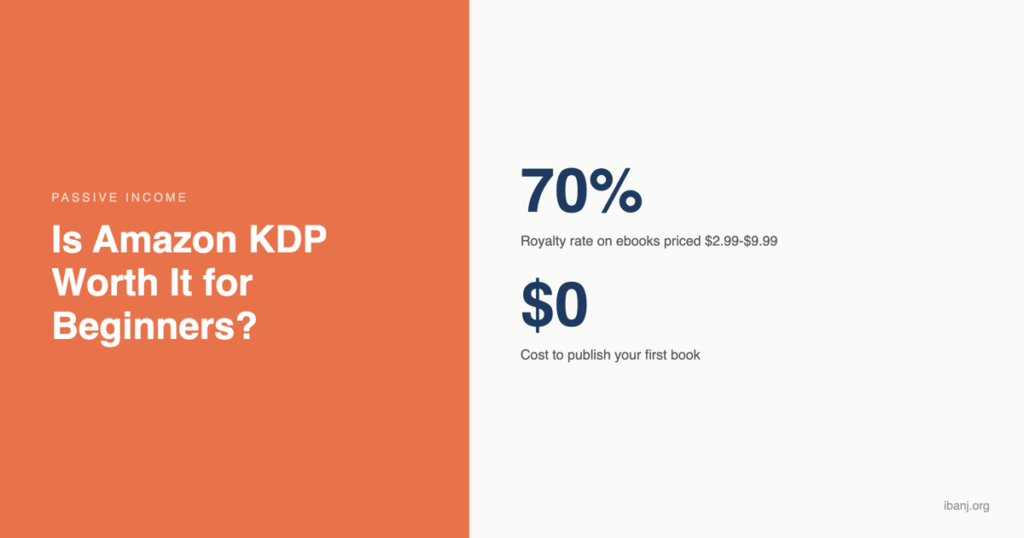
Amazon KDP is worth it for beginners who can commit to publishing multiple titles over six to twelve months, but most new authors earn less than $500 in their first year. KDP pays a 35% or 70% royalty depending on price, and the real money comes from building a backlist of five or more books in a focused niche rather than publishing a single title and hoping for the best.
Amazon Kindle Direct Publishing lets anyone publish an ebook or paperback for free. No agent, no publisher, no gatekeepers. According to Amazon’s KDP portal, independent authors earned more than $2.2 billion in royalties through the platform in recent years. That figure sounds enormous. The reality for individual beginners is far more modest.
This guide breaks down exactly how KDP royalties work, what genres and formats actually sell, and an honest assessment of whether the time investment makes sense. For a broader comparison of passive income methods, see our passive income guide.
How Do KDP Royalties Actually Work?
Amazon offers two royalty tiers for ebooks. The 35% royalty option applies to books priced between $0.99 and $200. The 70% royalty option applies to books priced between $2.99 and $9.99 in most markets. Delivery costs (based on file size) are deducted from the 70% tier only.
For a $4.99 ebook on the 70% tier, your royalty is roughly $3.44 per sale after delivery fees. For a $0.99 book on the 35% tier, you earn $0.35 per sale. Paperback royalties are 60% minus printing costs, which vary by page count and trim size. A 200-page paperback priced at $12.99 typically nets $2.50 to $3.50 per copy.
Kindle Unlimited pays through KENP (Kindle Edition Normalized Pages). According to KDP community reports, the per-page read rate fluctuates between $0.004 and $0.005 per page. A 250-page book read completely earns roughly $1.00 to $1.25 through KU. This matters because a significant portion of fiction readers use Kindle Unlimited.
Which Types of KDP Books Actually Make Money?
| Book Type | Royalty per Unit | Competition | Time to Create | Passive Potential |
|---|---|---|---|---|
| Non-fiction (how-to) | $2.50-$4.50 | Moderate | 40-100 hours | High |
| Fiction (romance, thriller) | $1.00-$3.50 | Very high | 80-200 hours | High with series |
| Low-content (journals, planners) | $1.50-$3.00 | Extreme | 2-10 hours | Low (saturated) |
| Medium-content (workbooks, guides) | $2.00-$4.00 | Moderate | 20-40 hours | Medium |
| Children’s books | $1.50-$3.00 | High | 20-60 hours | Medium |
Here is my honest assessment: low-content books are no longer a viable entry point. The category is flooded with thousands of nearly identical journals and planners. When I last checked the top-selling KDP categories, low-content books that ranked well almost all had established review counts above 100. A new entrant publishing a blank journal faces near-impossible odds.
Non-fiction how-to books in specific niches remain the best opportunity for beginners. A focused guide on a topic you know well (home canning, aquarium care, beginner woodworking) can sell steadily for years with minimal competition if the niche is specific enough.
How Much Can a Beginner Realistically Earn in the First Year?
Most first-time KDP authors earn between $50 and $500 in their first year from a single title. According to a Written Word Media survey, the median self-published author earns under $1,000 annually. Authors who publish five or more titles in a focused niche earn significantly more, with the median rising to $5,000 to $10,000 per year.
The math is straightforward. One book selling 10 copies per month at a $3.50 royalty earns $420 per year. Five books in the same niche, cross-promoting each other, selling a combined 60 copies per month, earn $2,520 per year. The backlist effect is where KDP becomes genuinely passive.
This timeline is slower than selling digital products on Etsy, which can generate first sales within weeks. But KDP books have longer shelf lives and Amazon handles all distribution.
What Does It Cost to Publish on KDP?
Publishing on KDP is free. Amazon charges nothing to upload, publish, or list a book. Your costs are in production. A professional book cover from a designer on 99designs or Fiverr runs $50 to $300. Professional editing for a 30,000-word non-fiction book costs $300 to $800 through services like Reedsy.
You can publish for $0 by designing your own cover in Canva and self-editing. The tradeoff is lower perceived quality, which directly affects sales. At minimum, invest in a professional cover. It is the single highest-ROI spending decision in self-publishing.
Is KDP Better Than Other Passive Income Methods?
KDP excels at long-term passive income with minimal ongoing maintenance. Once published, a book can sell for years without updates. The downside is the slow ramp-up and the fact that Amazon controls your distribution channel. If Amazon changes its algorithm or KU payout rate, your income shifts overnight.
For faster returns, Etsy digital products or print on demand generate revenue sooner. For higher income potential, starting a blog or YouTube channel builds an asset you own. KDP works best as one component of a diversified passive income portfolio, not as your only bet. Read our research methodology for how we verify these earnings claims.
-
A small percentage of authors earn a full-time living from KDP, typically those with 20 or more titles in a profitable niche like romance or thriller fiction. For most beginners, KDP is best treated as supplemental income alongside other methods.
-
No. Many publishers hire ghostwriters through platforms like Reedsy or Upwork. A 20,000-word non-fiction book costs $500 to $2,000 to ghostwrite. This turns KDP into an investment model: spend on production, earn royalties over time.
-
The upload and review process takes 24 to 72 hours. Writing and producing a 25,000-word non-fiction book typically takes four to eight weeks of part-time work. Your book can be live on Amazon within two months of starting.
-
Only if you enroll in KDP Select, which includes Kindle Unlimited. KDP Select requires 90-day exclusivity windows. Standard KDP publishing has no exclusivity requirement, meaning you can also sell on Apple Books, Kobo, and other platforms.
Sources
- Amazon Kindle Direct Publishing – Official KDP portal and royalty terms
- KDP Pricing and Royalty Details – Official royalty calculator and tier descriptions
- Reedsy – Professional editing and book cover design marketplace
- Written Word Media – Self-publishing industry surveys and data